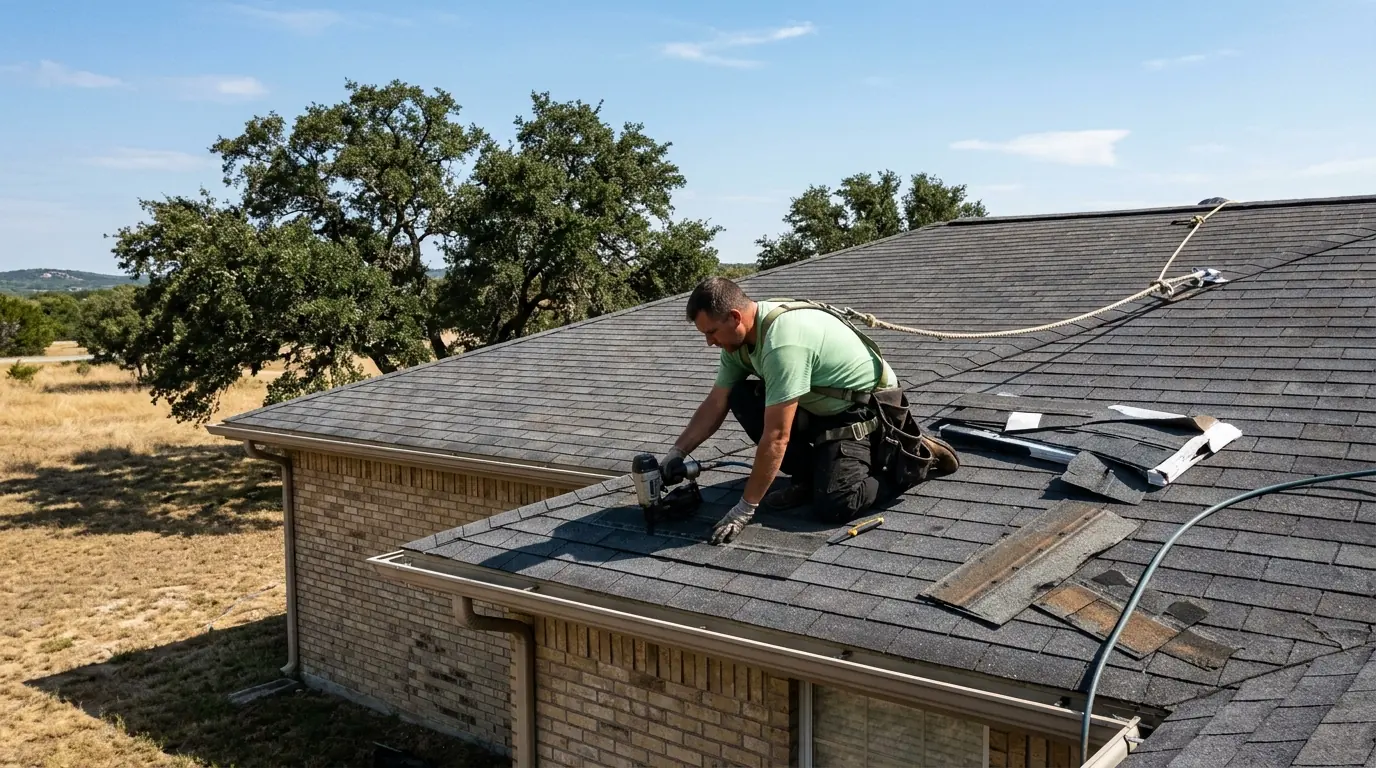
- Why does my roof only leak when it rains hard?
- Why does it only leak when the wind blows a certain way?
- So where is the water actually getting in?
- The roofer came out and couldn't find anything. Now what?
- Could it be a wall or window instead of the roof?
- Will insurance cover a leak from wind-driven rain?
- What should I do the next time it storms?
It's been dry for weeks. Then a storm rolls in with real wind behind it, and there's a drip by the window again. The next week it rains just as hard with no wind, and nothing happens. You start to wonder if you're imagining it.
You're not. A leak that only shows up in hard or wind-driven rain is real, and it's one of the hardest kinds to find. The opening is usually small and sits where water doesn't reach in a normal rain: under a lifted shingle, behind flashing where the roof meets a wall, or around a vent or skylight. Wind pushes water sideways, and sometimes uphill, into gaps that stay dry when rain falls straight down.
Why does my roof only leak when it rains hard?
Because a light rain runs off before it reaches the gap. A downpour puts more water on the roof than the valleys and gutters can carry away at once. Water backs up in valleys, behind chimneys and in clogged gutters, rises past the edge of the flashing, and finds the opening. When the rain eases, the water drops back below the gap and the drip stops.
Overflowing gutters can do this on their own. When they back up in a heavy rain, water can work under the edge of the roof and show up on a wall or ceiling near the outside of the house.
Why does it only leak when the wind blows a certain way?
Shingles and flashing are made to shed water running downhill. Strong wind drives rain sideways and even uphill, under shingle edges and behind flashing. A shingle whose seal has let go can lift in a gust just enough to let water in, then lie flat again so it looks fine from the ground.
That's why direction matters. If the weak spot faces west, an east wind never touches it. It's often one side of the house and one kind of storm.
Copperas Cove gets those storms. NOAA storm records include a 60 mph gust measured in town in April 2010, wind damage to roofs around Copperas Cove in April 2019, and an 82 mph gust recorded near Kempner on May 1, 2025, the same day as the big hail, with shingle damage reported in the area. The June 2019 tornado along Big Divide Road left what the National Weather Service called "significant shingle" damage on homes along its path. Wind comes up again and again in local roofer reviews too, in lines like "after a wind gust blew a few shingles off."
So where is the water actually getting in?
Wind-driven leaks start at the same few places, the ones we list under where roofs in Copperas Cove usually leak:
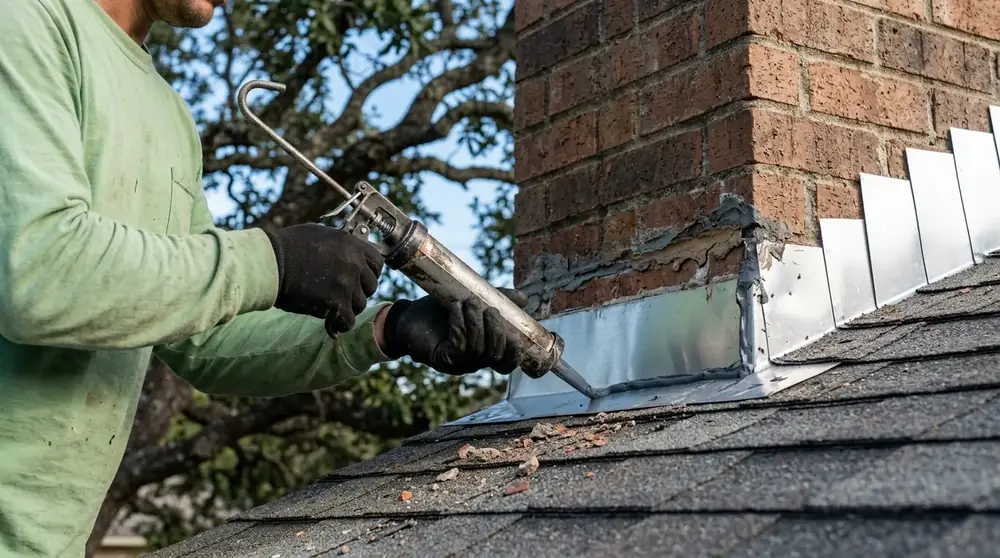
- Where the roof meets a wall. Think of a second-story wall or a garage roof that ties into the house. Small pieces of flashing step up along that line. If one is missing or too short, sideways rain runs behind the siding and down inside.
- Chimneys and skylights. The flashing around them takes the wind head-on from one side. Skylights can also leak at the seals around the glass.
- Roof vents. Box vents and ridge vents are open by design. A damaged or poorly fitted vent lets wind blow rain straight into the attic.
- Lifted shingles. Shingles that came unsealed, or nails that backed out, let water under only when the wind lifts them.
- Roof edges. The lower edge and the sloped side edges catch wind-driven rain first. A loose drip edge lets it curl back under.
- Gable vents. The louvered vents high on the end walls of the attic can let sideways rain blow right in. That isn't the roof, but it shows up on the ceiling like a roof leak.
The roofer came out and couldn't find anything. Now what?
That happens a lot with this kind of leak, and it doesn't mean the roofer was careless. On a dry, calm day the gap looks fine. Two things help:
- A hose test aimed the way the storm hit. One person runs water over one small area at a time, starting low and working up, sometimes spraying at an angle to copy the wind, while someone watches in the attic. It's slow, but it's how these leaks get found.
- Your notes. Tell the roofer which way the wind was blowing, how hard it rained, and how long before the drip started. That narrows a whole roof down to one side and a few likely spots.
If it was already patched once and keeps coming back, read why a roof keeps leaking after a repair.
That's the work we do. We start in the attic, trace the water to where it gets in, and show you photos of what failed and the price before any work starts. Here's how our roof leak repair works.
Could it be a wall or window instead of the roof?
Yes, and with wind-driven rain it's worth ruling out. Rain blown against siding, brick or a window can get in around the window frame or through cracked caulk and run down inside the wall.
Clues it isn't the roof: the water shows up at the top of a window or along a wall instead of out in the ceiling, the attic above it stays dry, and it only happens when rain hits that wall directly. If the attic wood above the spot is wet, it's the roof.
Will insurance cover a leak from wind-driven rain?
It depends on your policy and on what let the water in. Many policies treat damage from a storm, like shingles torn off by wind, differently from a leak caused by wear or a part that failed with age. Only your policy and your adjuster can answer it for your house.
Either way, two things help: dated photos of the damage and the drip, and a written note from whoever finds the leak saying exactly what failed.
What should I do the next time it storms?
Treat the next storm as your best chance to find it.
- When the drip starts, check the wind direction on your phone's weather app and write it down with the time.
- Take a dated photo or short video of the drip.
- If it's safe, go into the attic with a flashlight while it's raining and look for where water is running. Step only on the joists.
- After the storm, look at the gutters on that side. Overflow marks or packed debris point to a backup.
- Stay off the roof. Wet shingles and wind are a bad mix.
- Don't caulk anything you can't prove is the source. Extra sealant just makes the real gap harder to find.