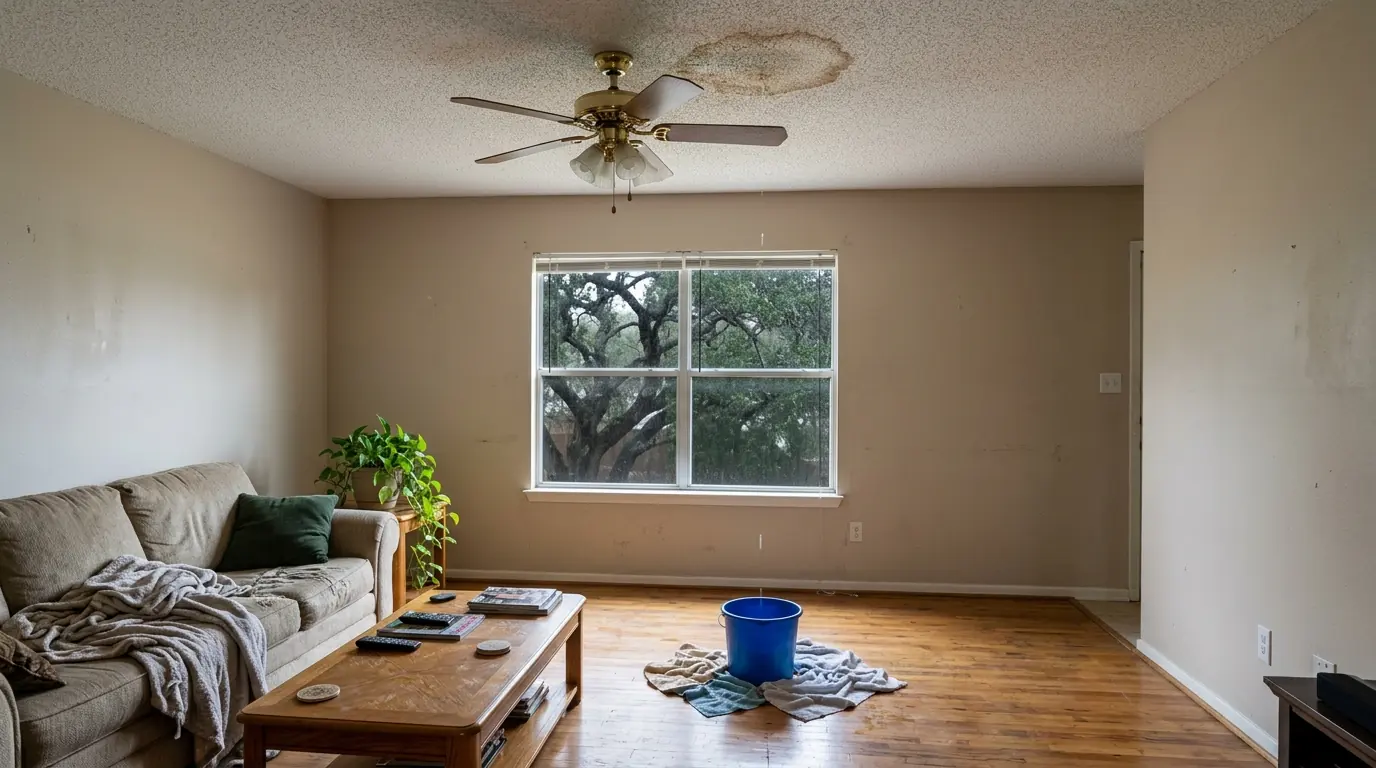
There's a wet spot on the ceiling, maybe a drip into a bucket, and your first thought is the roof. Then you remember it hasn't rained in a week. Or it has, but the spot is right under the air handler in the attic. Now you don't know who to call.
Start with the weather. If the water shows up during a rain or right after one, and grows with each storm, it's almost always the roof. If it shows up on a dry day, especially a hot one with the AC running hard, the AC drain is the first suspect. Near a bathroom or kitchen, or after a hard freeze, think pipes.
Here's how to tell them apart in a few minutes, so you call the right person the first time.
Is the water coming from my roof or my AC?
Ask two questions: when does it drip, and where is it?
- Drips during or after rain, and the stain gets bigger with each storm: roof.
- Drips on dry days, mostly in summer, and it's close to the AC unit or a ceiling vent: AC.
- Drips any time, near a bathroom, kitchen or water heater: plumbing.
Our homepage has the short version of this, under is it the roof or something else? The rest of this page walks through each one.
It hasn't rained in a week. Why is my ceiling wet?
In a lot of Texas homes, the AC's indoor unit sits in the attic. While it cools, it pulls water out of the air. That water drips into a pan under the unit and runs outside through a small drain pipe. When the drain clogs, the pan fills up and overflows onto the ceiling below.
Copperas Cove summers push that system hard. August highs average in the mid-90s, so the AC runs for hours and makes a lot of water. That's why an AC leak tends to show up in the hottest stretch of summer, often with no rain in sight.
Quick checks:
- Look at the outside wall near the eaves, or above a window, for a small pipe that's dripping. Many Texas systems have a backup drain there. If it's dripping, the main drain is likely clogged.
- If you can safely get into the attic, look at the pan under the unit. Standing water in it points to the AC.
- Turn the AC off. If the drip slows or stops within a few hours, that's your answer.
If it's the AC, that's a job for an AC company, not a roofer.
It's near a bathroom or kitchen. Could it be a pipe?
Yes. A leaking supply line, drain or toilet seal can soak a ceiling, and it doesn't care about the weather.
The easiest test is your water meter. Turn off every faucet and appliance, then watch the meter for 15 minutes. If it moves, water is leaking somewhere in the plumbing.
One spot fools a lot of people: the plumbing vent pipe that goes up through the roof. If the rubber boot around it on the roof is cracked, that's a roof leak. If the pipe itself is loose or broken in the attic, that's plumbing. Either way, the water shows up in the same place on the ceiling.
The ceiling got wet after a freeze. Roof or pipe?
Could be either, so check the timing. Copperas Cove has had its share of winter storms, including the historic February 2021 storm with snow, ice and single-digit lows, an ice storm in February 2023, and sleet in January 2026.
- Water as soon as the temperature drops, or right when things start to thaw: suspect a frozen pipe that split in the attic or an outside wall. Shut off the main water valve first.
- Water as the snow and ice on the roof melt: that's the roof. Melting ice can work under shingles and flashing that are already weak.
Both happen here. One local roofer review describes "a leak after the snow storm" that the roofer fixed on the roof. Another mentions "water damage in 5 rooms after the last snow/ice storm."
How do I know for sure it's the roof?
Go into the attic during or right after a rain, if it's safe, and look above the wet spot. Signs it's the roof:
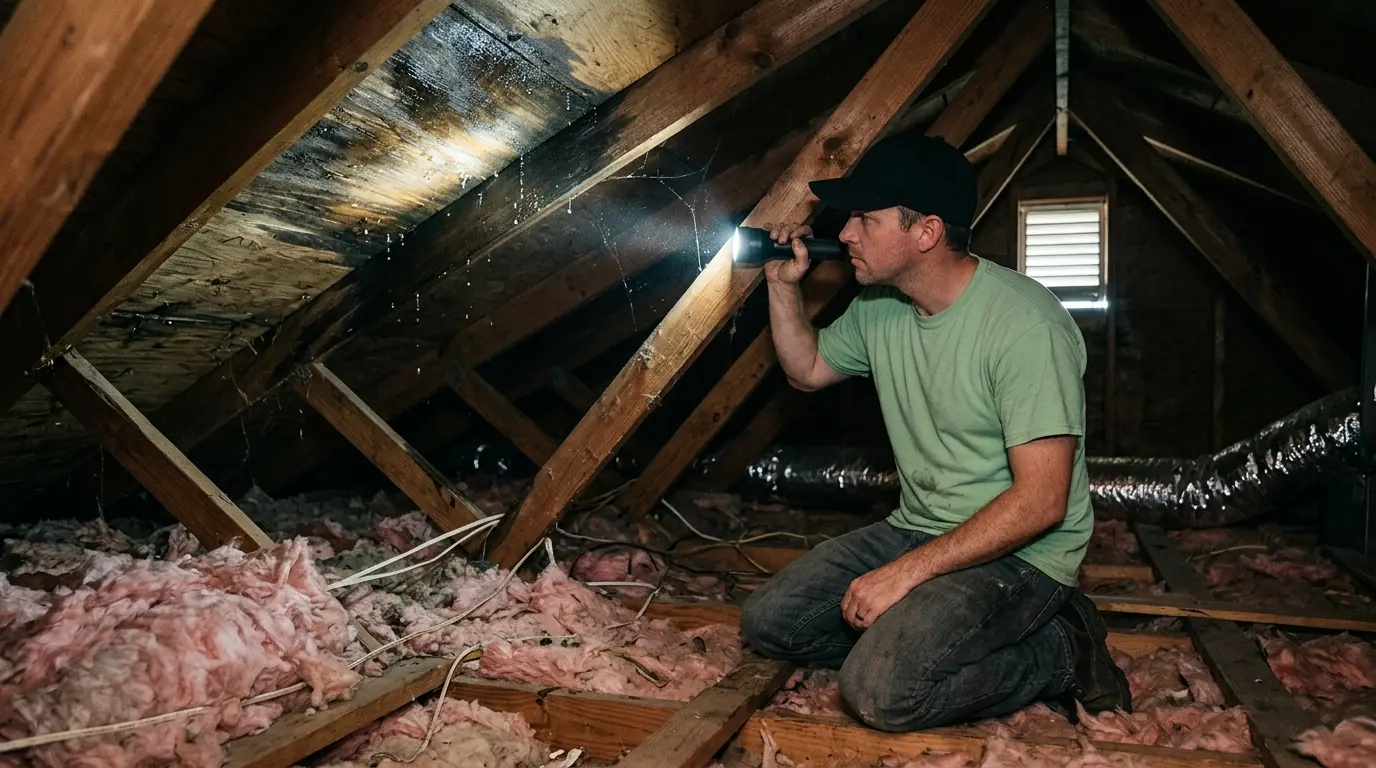
- Wet or dark streaks on the underside of the roof deck or down a rafter.
- Water running along the wood from higher up, not dripping from the AC unit or a pipe.
- Damp insulation right under a vent, chimney, skylight or the line where two roof slopes meet.
- A brown ring on the ceiling that gets a new, bigger edge after each storm.
Keep in mind the wet spot on the ceiling is usually not right under the hole. Water travels along the wood before it drops. If it only shows up in certain storms, read why some roofs only leak in hard or sideways rain.
I checked and still can't tell. Now what?
Call a roofer who starts in the attic, not one who just climbs up and looks at shingles. Following the water from the wet spot back to where it starts usually settles it. If it turns out to be the AC or a pipe, a good roofer will tell you that instead of selling you a repair you don't need.
That's how we do it. We trace the water first, show you photos of what we found, and give you the price before any work starts. Here's how our roof leak repair works.
What should I do right now?
- Put a bucket and towels under the drip and move anything that can get ruined.
- If the drip is near the AC unit or a ceiling vent, turn the AC off.
- If it's near a bathroom or kitchen and won't stop, turn off the water at the main valve.
- If water is near a light fixture or outlet, turn off that breaker.
- Take dated photos, and write down whether it was raining, how hot it was, and whether the AC was running.
Those notes are the fastest way for whoever comes out to find the source.